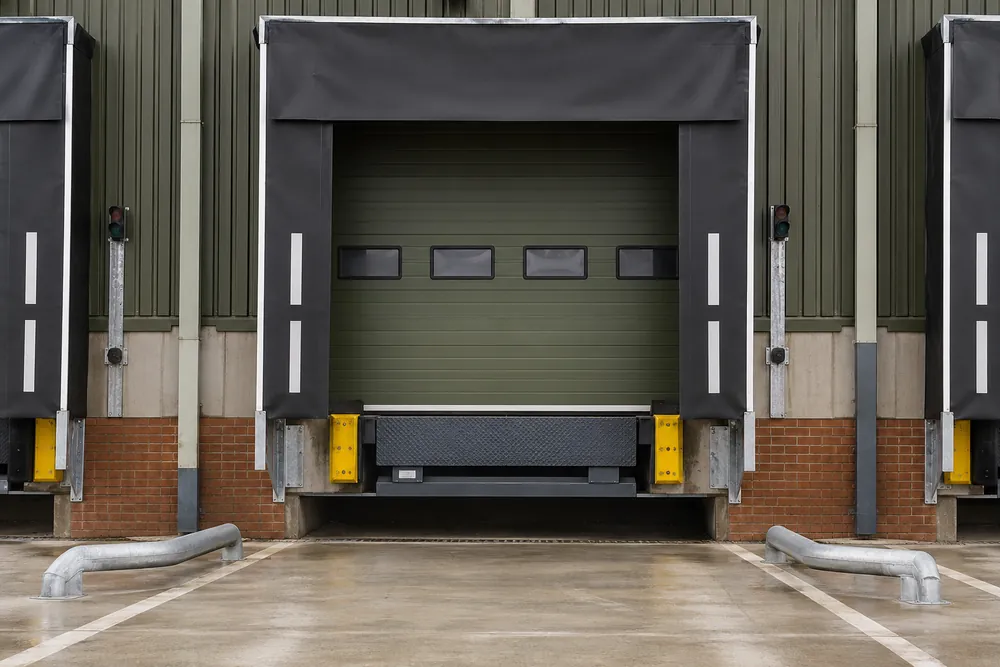
Look Beyond The Door Opening
A loading bay brings together the building, delivery vehicle and materials-handling equipment. The door cannot be specified well without understanding those interfaces. We help Liverpool commercial sites describe the requirements for loading bay doors, dock levellers and related control arrangements.
A dock leveller bridges the difference between the loading platform and the vehicle floor. Its working range, platform size and capacity must match the intended vehicles and equipment. The combined loading conditions need review, including concentrated wheel loads and the movement of the vehicle suspension.
A bay survey should consider the delivery fleet rather than assuming every trailer is identical. Vehicle floor heights, rear openings, tail lifts and approach angles can change what is practical. Existing dock shelters and buffers also affect the final position of the vehicle against the building.
Door And Leveller Coordination
Sectional doors are often used at loading bays where the overhead space allows a suitable track layout. Panel construction, seals, glazing and controls should reflect the building conditions. The door must not interfere with the leveller, shelter or normal loading path.
Interlocks can help coordinate the operating sequence where the risk assessment calls for them. For example, a defined sequence may prevent incompatible movements between bay equipment. The details depend on the existing controls and must be documented rather than assumed from the presence of a shared control panel.
Dock shelters can help reduce exposure at the vehicle interface, but they introduce their own access and trapping considerations. Damaged shelters, displaced buffers and impact to the door frame should be reported together. Repairing only the visible door panel can miss the cause of repeated collisions.
Safe Access For People And Vehicles
Review pedestrian routes, sight lines and the way drivers communicate with warehouse staff. A delivery driver may be unfamiliar with the site, so the loading procedure needs to be clear. The bay design should support that procedure instead of depending on informal signals between people who cannot see each other.
Vehicle movement during loading must be controlled through an appropriate site system. The correct measures depend on the fleet, bay layout and operation. Door status alone does not prove that a vehicle is safely positioned or prevented from leaving.
Maintenance beneath a raised dock leveller requires the correct supporting arrangement, safe isolation and a controlled work area. Never rely on hydraulic pressure alone to hold equipment for access. Operators should not enter a pit or attempt to release a trapped component as an improvised repair.
Assessment, Works And Handover
Begin with bay photographs, equipment identification details and a description of the problem or new requirement. The survey should inspect the opening, mounting points, pit condition where relevant and the interface between controls. Structural or drainage concerns may require separate specialist input.
The written scope should distinguish door works, leveller works and changes to surrounding equipment. Agree how the bay will be isolated from deliveries while the work takes place. Commissioning should test the agreed operating sequence and the protective functions of the complete arrangement.
Handover should include instructions for the installed equipment, the defined sequence and a record of outstanding restrictions. Staff who operate the bay need appropriate instruction. A technical handover to a manager does not replace practical familiarisation for the people using the equipment on shift.
- Survey the door, pit, vehicle interface and connected controls.
- Define the works for each asset and agree delivery restrictions.
- Complete the authorised works with safe isolation and access.
- Test the coordinated bay sequence and record operating instructions.
Standards, Quotation And Future Care
BS EN 1398:2009 covers dock leveller safety requirements, including matters relevant to construction, installation, maintenance and testing. The actual leveller and site arrangement still need a competent assessment. Read the BSI dock leveller standard summary and HSE loading area guidance for the underlying context.
Quotation factors include door size, leveller type, pit repairs, lifting access, controls and the working window available. A coordinated maintenance plan can cover the door and bay assets together while keeping separate findings for each item. Describe your loading operation through our enquiry form to start the assessment.
Managing Work Equipment Duties
Commercial loading bay equipment needs suitable maintenance and safe operating arrangements under applicable work equipment duties. Keep the assessment specific to the door, leveller and associated equipment. Do not assume that every item has identical inspection or statutory examination requirements, and ask a competent adviser where the classification is unclear.
Your Questions Answered
Can A Dock Leveller Be Repaired Without Replacing The Door?
A dock leveller can often be assessed separately from the loading bay door, but the control relationship and physical clearances still need checking. A repair scope should identify hydraulic, mechanical and electrical findings, along with any issues at the pit or supports. The equipment must remain out of service wherever its condition prevents safe use.
What Information Helps With A Loading Bay Enquiry?
A loading bay enquiry is more useful with photographs of the whole bay, the door, dock leveller and accessible identification plates. Describe the vehicle types, loading equipment and any faults or impacts. Include whether the bay is currently out of use and any access restrictions, but take photographs only from a safe position outside the loading operation.